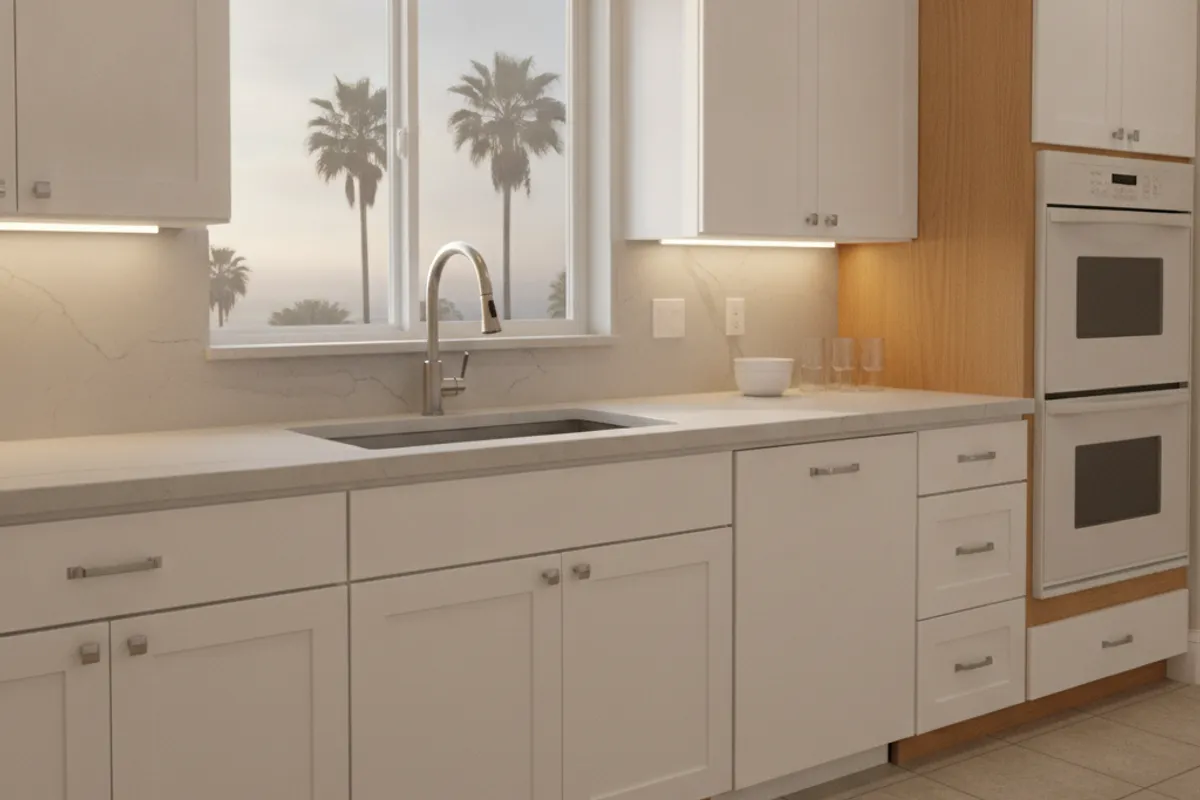
Why coastal kitchens are a different conversation
San Diego’s reputation for perfect weather is mostly true, but “mild” doesn’t mean “dry.” Coastal neighborhoods from Coronado to Carlsbad see marine layer most mornings, ambient humidity that fluctuates between 60-85% depending on the season, and occasional salt air from onshore winds. That environment affects wood-containing building materials over time, and kitchen cabinets near the coast are no exception.
Inland San Diego in El Cajon, Santee, Rancho Bernardo, and Poway is genuinely drier. Cabinets there behave more predictably with a wider range of materials. Coastal San Diego requires a more deliberate material conversation before ordering anything.
The specific concerns for coastal kitchen cabinets
Veneer seam adhesion
Wood veneer applied to cabinet box faces is bonded with contact adhesive. That adhesive bond holds well in stable conditions. In environments with cycling humidity, particularly where the kitchen is near an open window in the morning marine layer and then dry in the afternoon, the underlying substrate expands and contracts slightly with the moisture cycle. Over years, this cycling can stress veneer seams and cause them to lift at corners or along filler strips at the ceiling.
High-pressure laminate handles this better than wood veneer because the laminate sheet is dimensionally more stable than wood-based veneer, and the adhesive bond on HPL is stronger.
Door substrate moisture response
Solid wood doors are the most dimensionally stable option, but they’re also the most expensive. Solid MDF doors are very stable for painted finishes and don’t expand and contract with humidity the way solid wood does. Thermofoil on MDF, a common builder-grade door type found in older coastal homes, is the most vulnerable to moisture: the vinyl film peels at the edges when humidity variation is significant.
Hardware corrosion
Salt air from onshore winds corrodes hardware faster than inland conditions. Stainless steel or solid brass hardware lasts significantly longer in coastal kitchens than zinc alloy or chrome-plated hardware. This is often an afterthought on a refacing quote, but it matters in Pacific Beach, Ocean Beach, or any kitchen within a half-mile of the water.
Under-sink cabinet boxes
This applies everywhere, not just on the coast: the cabinet box under the sink is the most moisture-exposed cabinet in the kitchen. It’s where plumbing connections live, where small drips go undetected, and where cleaning products are stored. For coastal homes, this box deserves extra attention at the inspection stage to confirm the bottom and sides are solid before veneer is applied over them.
What to specify for a coastal San Diego refacing project
Box face material: high-pressure laminate
For kitchens within two to three miles of the coast, HPL on the box faces is the conservative and correct choice. It holds its adhesion better in cycling humidity conditions than wood veneer. The difference in price is $25-$50 per linear foot on the box faces, which is real money on a 25-linear-foot kitchen, but it matters for longevity.
Door material: solid wood or solid MDF
For painted finishes, solid MDF is the most stable choice in coastal conditions. For stained finishes, solid wood is the right call. Avoid thermofoil or plastic-laminate-wrapped MDF doors in kitchens that experience regular marine layer humidity.
Hardware: stainless steel or solid brass
Specify corrosion-resistant hardware at the start. Standard zinc alloy or chrome-plated pulls start to show surface corrosion within 3-5 years in close coastal proximity. Stainless steel or unlacquered brass develops a natural patina but doesn’t fail structurally. The cost difference per pull is $2-$8, negligible on the total project.
Hinge material
Quality concealed hinges from Blum and Grass use nickel-plated steel and are reasonably corrosion-resistant. Cheap generic hinges use less-protective coatings and may show rust at the hinge cup within a few years in salt air environments.
Neighborhoods where these considerations apply most
Within one mile of the coast: Coronado, Ocean Beach, Mission Beach, Pacific Beach, La Jolla Shores, Cardiff, Encinitas, Carlsbad beach communities. Maximum scrutiny on materials. HPL box faces, MDF or solid wood doors, stainless hardware, quality hinges.
One to three miles from the coast: Most of La Jolla, Point Loma, Del Mar, Solana Beach. Same recommendations apply with slightly more flexibility on box face material.
Three to six miles from the coast: Most of Mission Hills, Hillcrest, North Park, Normal Heights, Clairemont. Standard material choices work well. HPL is still a reasonable preference; wood veneer is acceptable.
Inland: El Cajon, Santee, Lakeside, Ramona, Rancho Bernardo, Poway, Escondido. Standard material choices appropriate. Material selection driven by aesthetics and budget, not moisture management.
What to ask the crew about coastal kitchens
Before signing, confirm that the crew has done projects in your specific neighborhood and understands the material implications. Ask:
- What box face material do you recommend for a kitchen at this address?
- What substrate are the doors made from?
- What hardware brand do you use, and is it rated for coastal conditions?
For a full overview of veneer versus laminate for box faces, see the veneer vs laminate comparison post. For the full refacing process, see the cabinet refacing service page.
Do I need to worry about cabinet refacing near the beach in San Diego?
Within a mile or two of the coast, material selection matters. High-pressure laminate for box faces, MDF or solid wood for doors, and corrosion-resistant hardware make the project significantly more durable than standard materials in those conditions. Ask the crew specifically about coastal recommendations before materials are ordered.
How often do I need to maintain refaced cabinets near the San Diego coast?
With the right materials, refaced coastal cabinets need the same minimal maintenance as any kitchen cabinet: wipe down with a damp cloth, avoid prolonged moisture at edges, check hinge alignment annually. Inspect veneer or laminate edges at the ceiling filler strip every two years. Catching a small lift early prevents a larger delamination later.
The bottom line
Coastal San Diego kitchens need a deliberate conversation about materials before a refacing project begins. High-pressure laminate for box faces, MDF or solid wood for doors, and corrosion-resistant hardware are the specifications that produce a 15-plus-year result in Pacific Beach, La Jolla, Encinitas, and similar neighborhoods. Inland kitchens have more flexibility.
Call (858) 925-5546 to connect with insured cabinet refacing crews serving San Diego County who understand coastal material requirements. Verify any contractor at cslb.ca.gov before signing.