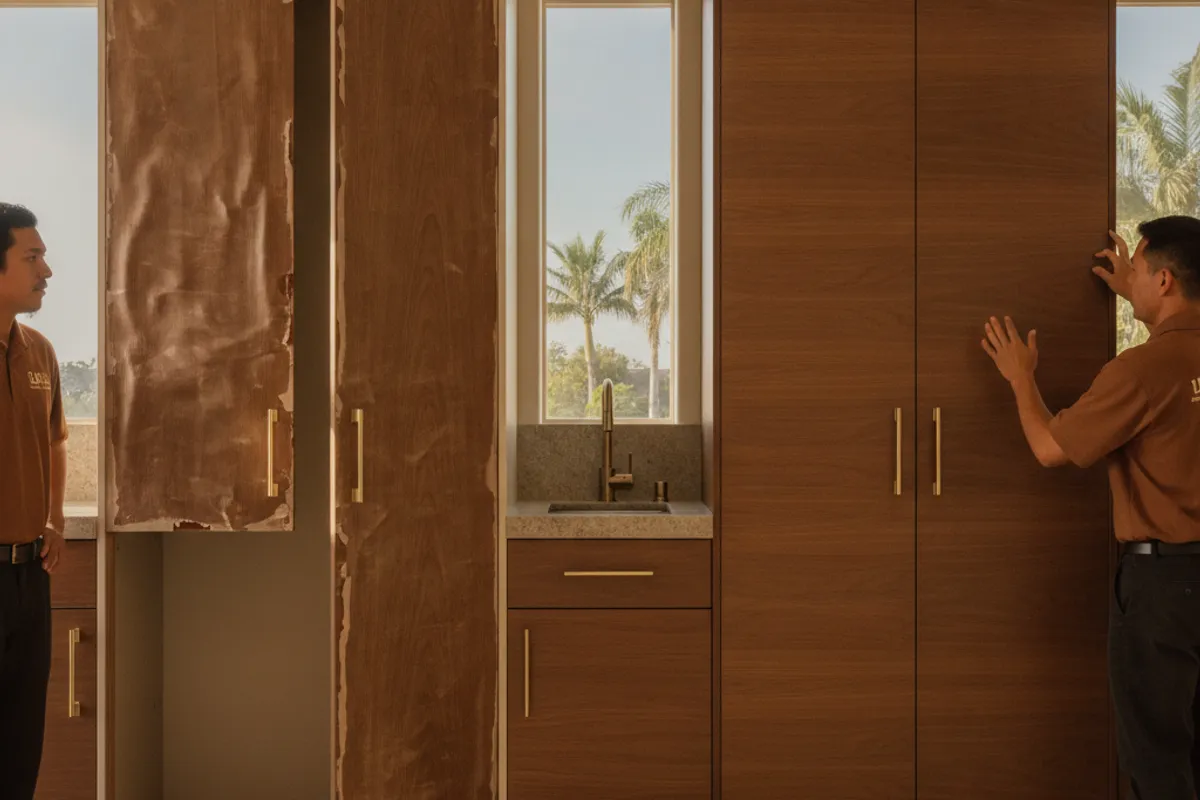
The case for DIY cabinet refacing
The appeal is real. A DIY refacing kit costs $300-$800 for materials on a mid-size kitchen. A professional refacing project runs $4,500-$9,000. That’s a $4,000-$8,000 difference in upfront cost, and for a homeowner with finish carpentry skills and time, DIY can produce a reasonable result.
The relevant question is what “reasonable result” actually means versus professional work, and what skills and time investment are required to get there.
What a DIY refacing kit typically includes
Most DIY refacing kits sold at home improvement stores or through cabinet refacing material suppliers include:
- Peel-and-stick wood-grain or solid-color veneer rolls for the cabinet box faces
- Iron-on edge banding for exposed box edges
- Pre-cut or custom-ordered door and drawer fronts
- New hinges
- Installation instructions
The veneer in these kits is typically paper-backed peel-and-stick, which is significantly less durable than the contact-adhesive commercial laminate or veneer used by professional crews. The edge banding is easier to apply than professional edge trimming but more prone to lifting over time.
Where the result differs
Seams and edges
Professional crews use commercial-grade contact adhesive, a J-roller to press veneer fully, and a flush-trim router bit or hand trim to get the edge exact. The result: seams that are invisible in normal light and edges that are flush with the box face.
DIY peel-and-stick veneer has more variables: the surface prep matters more because there’s no adhesive to fill surface irregularities, and the trim quality depends on the homeowner’s patience and skill with a utility knife. Visible seams and slightly raised edges are common on DIY results.
Door fit and hang
Factory-ordered doors come with consistent dimensions. Professional crews adjust hinge positioning so every door in a run of 12 upper cabinets hangs at the same height with consistent reveals. Getting this right across a full kitchen requires a trained eye and methodical adjustment, not just following instructions.
A DIY result with doors 1-2mm off in height or reveal is normal. A professional result with all doors in a run perfectly aligned is also normal, and the difference is visible when you step back and look at the kitchen as a whole.
Filler strips and transitions
Where the cabinet run meets the ceiling, the wall, or the floor, custom-cut filler strips close the gap. These require measuring, cutting, and fitting strips that account for ceilings that aren’t perfectly level (common in San Diego homes built before 1970) and walls that aren’t plumb. Professional crews do this work as part of every job. DIY kits rarely account for it.
Where DIY is actually viable
Replacing just the doors on simple, accessible cabinets
If the goal is simply to swap the doors on a small, accessible kitchen, and the box faces are in good condition and don’t need covering, ordering new doors and hanging them yourself is a reasonable project. The hinge adjustment takes patience but is learnable. This isn’t full refacing, but it updates the look significantly.
A garage, laundry room, or secondary bathroom
Lower-visibility spaces tolerate a less-perfect result. If the veneer edge isn’t flawless on the laundry room cabinet, no one is photographing it for a real estate listing.
A homeowner with finish carpentry skills
Someone who has done built-ins, trim work, or kitchen installations before will produce a much better DIY result than someone doing finish work for the first time. The skills transfer directly.
Where DIY fails most often
Large kitchens
The number of seams, transitions, and door alignments compounds with kitchen size. Getting 40 doors hung consistently across a full kitchen is harder than getting 20 right.
Coastal San Diego homes
The peel-and-stick veneer in DIY kits is the worst choice for coastal humidity conditions. It lifts faster than contact-adhesive commercial laminate and produces worse results in any kitchen that sees regular humidity variation.
Pre-sale projects
If the kitchen is being refaced to improve resale value, the result needs to photograph well and hold up for buyer inspection. Professional work produces a result that buyers accept as an updated kitchen. DIY results are sometimes identifiable as DIY, which undercuts the return.
The realistic cost comparison
DIY materials: $400-$900 for a mid-size kitchen (peel-and-stick veneer rolls, edge banding, doors, hardware). Time: 3-6 full weekends depending on skill level.
Professional refacing: $4,500-$9,000 for the same kitchen. Time: 2-4 days, you don’t do the work.
The honest comparison isn’t just the dollar difference. It’s the dollar difference minus the value of 3-6 weekends of labor, plus the quality difference, plus the durability difference. For many San Diego homeowners, the professional project is the better value.
For information on the professional refacing process, see the cabinet refacing service page. For a breakdown of what affects professional refacing costs in San Diego, see the cabinet refacing cost guide.
Can I do cabinet refacing myself in San Diego?
You can reface cabinets yourself using kits from home improvement stores or door suppliers. The result is typically inferior to professional work in seam quality, door alignment, and long-term durability. DIY is a reasonable choice for secondary spaces, low-visibility kitchens, or homeowners with existing finish carpentry skills.
How hard is DIY cabinet refacing?
Covering box faces with peel-and-stick veneer is straightforward but tedious. Hanging doors consistently across a full kitchen run takes more skill and patience. The filler strip and transition work at ceilings and walls is the most skill-dependent part. Plan for more time than the instructions suggest.
Is DIY refacing worth it in San Diego?
For primary kitchens, especially in coastal areas or homes being prepared for sale, professional refacing is usually the better investment. For secondary spaces and homeowners with carpentry skills, DIY produces an acceptable result at significantly lower material cost.
The bottom line
DIY cabinet refacing saves money on materials but requires significant time, skill, and patience to produce a result that compares to professional work. The gap is widest on full kitchens, coastal homes, and pre-sale projects. Professional refacing is the right call when the kitchen matters for resale, the space is high-visibility, or the homeowner’s time is limited.
Call (858) 925-5546 to connect with insured cabinet refacing crews across San Diego County. Verify any contractor at cslb.ca.gov before signing.