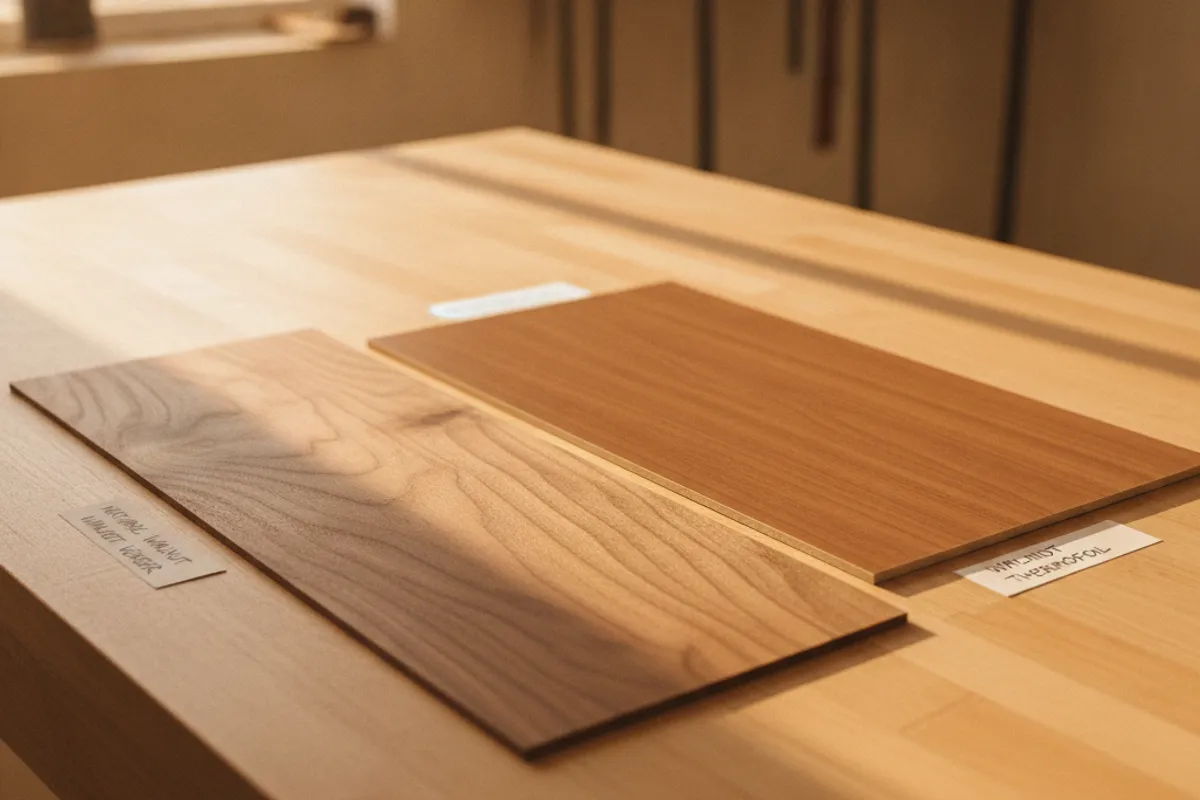
The material choice that drives the rest of the project
When you reface your cabinets, the two core material options for the cabinet box faces are wood veneer and laminate. The doors and drawer fronts are a separate choice: those can be solid wood, MDF, thermofoil, or laminate regardless of what goes on the box face. But the box face material sets the tone for the finished result and influences the total project cost by $500-$2,000 in either direction for a typical San Diego kitchen.
Understanding the difference between the two materials helps you make the choice that fits your kitchen and your priorities.
What wood veneer is
Wood veneer is a thin slice of real wood, typically 1/28 to 1/42 of an inch thick, applied to the cabinet box face using contact adhesive. The grain, texture, and color variation are real wood. After application, the veneer can be stained or painted to match the new doors.
Most refacing veneers use species like maple, birch, cherry, oak, or alder. Maple and birch are common for painted finishes because their tight grain accepts primer and paint evenly. Cherry and alder are popular for stained finishes where the natural wood character is meant to show.
Advantages:
- Looks like real wood because it is real wood
- Can be stained to any natural wood tone, or painted
- Accepts touch-up refinishing if scratched or worn
- Works well when you want the cabinet boxes to match solid-wood doors exactly
Disadvantages:
- More expensive than laminate: add $30-$60 per linear foot over laminate for the same kitchen
- More sensitive to moisture at the seam edges: if water gets under the edge, veneer can lift over time
- Requires more skill to apply cleanly: poorly fitted veneer shows seams and gaps
What laminate is
Laminate refacing uses a rigid thermoplastic sheet bonded to the cabinet box face. It’s the same general category as formica countertops or the exterior surface on many manufactured doors. Modern laminates come in hundreds of colors and patterns, including convincing wood-grain prints.
High-pressure laminate (HPL) is the more durable version, and it’s what quality refacing crews use on box faces. It’s harder than the surface of most wood veneers and resists nicks, scratches, and moisture better.
Advantages:
- Less expensive than wood veneer: save $25-$50 per linear foot on box faces
- More moisture-resistant: better choice for cabinets near the sink, dishwasher, or in coastal San Diego homes where humidity fluctuates
- More consistent color: no grain variation or staining risk
- Easier to source in non-wood colors: white, gray, navy, sage, and other solid colors look clean in laminate
- Easier for crews to cut and fit cleanly
Disadvantages:
- The wood-grain prints, while convincing, look slightly different from real veneer up close
- Can’t be stained: if you want a different color in the future, you’re repainting or refacing again
- Solid color laminates show dings and scratches more than textured finishes
- Edges need careful fitting: exposed core at a cut edge looks unfinished
Which material works better in San Diego
San Diego’s climate is mild, but kitchens near the coast in La Jolla, Pacific Beach, Ocean Beach, and Encinitas face more humidity variation and occasional salt air than kitchens in Santee, El Cajon, or Poway. That variation matters for cabinet box face materials.
For kitchens within a few miles of the coast, laminate is the safer choice for the box face veneer. The seams on laminate are bonded more reliably against moisture than wood veneer seams, and the core is not affected by moisture the way MDF-backed veneer can be.
For inland San Diego kitchens, the material choice is driven more by aesthetics and budget. If you’re going for a stained wood look with matching wood doors, veneer is the natural fit. If you’re going for painted white or a solid color, laminate is the more practical choice.
How the box face material relates to the doors
The box face material and the door material are separate decisions. You can use laminate on the box faces and solid wood Shaker doors. You can use veneer on the box faces and MDF painted doors. The goal is that the visible finish color and texture read as cohesive when the doors are closed.
The most common mismatch to avoid: applying stained wood veneer to the box faces and ordering painted white doors. The stained veneer edges will show around the door perimeter if the door doesn’t fully cover them, creating a visible color contrast where the door meets the frame.
For guidance on matching door style and material to your refacing project, see the custom cabinet door options page. For the full overview of what the refacing process involves from material selection through installation, see the cabinet refacing service page.
What to ask the crew
Before committing to a material, ask:
- What laminate brand or veneer source do you use? (Higher-quality laminates have more convincing textures; better veneers have fewer figure defects)
- Can I see a sample of the specific material in the color I’m considering?
- How do you handle the edge at the ceiling or against the wall?
- What’s your moisture protection practice at seam edges?
The bottom line
Wood veneer looks like real wood because it is real wood, and it costs $25-$60 more per linear foot than laminate. Laminate is more moisture-resistant, more consistent in color, and the better choice for coastal San Diego kitchens or any kitchen where you want painted solid-color box faces. For stained-wood looks, veneer is the natural fit. For painted or solid-color finishes, laminate is the practical choice.
Call (858) 925-5546 to connect with insured cabinet refacing crews across San Diego County who can show you samples of both materials in your kitchen. Verify any contractor at cslb.ca.gov before work starts.