Why a refacing project is the best time to add soft-close hardware
Soft-close hinges and drawer slides can be added to existing cabinets as a standalone project, but it’s more disruptive and more expensive per hinge to do it separately. During a cabinet refacing project, every door and drawer front is already off the boxes. The crew is already installing new hinges for the new doors. Adding soft-close hardware at this stage is just a matter of specifying the right hinge at the start rather than swapping it in later.
The incremental cost at refacing time is $15-$30 per door or drawer. On a 28-door kitchen, that’s $420-$840 added to the project. Doing the same upgrade as a standalone project later typically runs $30-$60 per door because labor is less efficient without the refacing work already underway.
What soft-close hinges actually do
A standard cabinet hinge holds the door in alignment and allows it to open and close. That’s it. The door slams when closed hard, and there’s nothing to slow it down.
A soft-close hinge has a hydraulic damper built into the mechanism. As the door reaches the last 15-20 degrees of closing, the damper engages and decelerates the door. The door closes quietly and fully without slamming. The mechanism resets automatically when the door is opened.
Quality soft-close hinges from manufacturers like Blum or Grass are rated for 75,000 to 100,000 cycles. At two open-close cycles per day per door, that’s roughly 100-140 years of normal kitchen use. The hydraulic mechanism is the component most likely to wear out first. On quality hinges, it typically lasts 10-20 years before losing the soft-close effect.
What soft-close drawer slides do
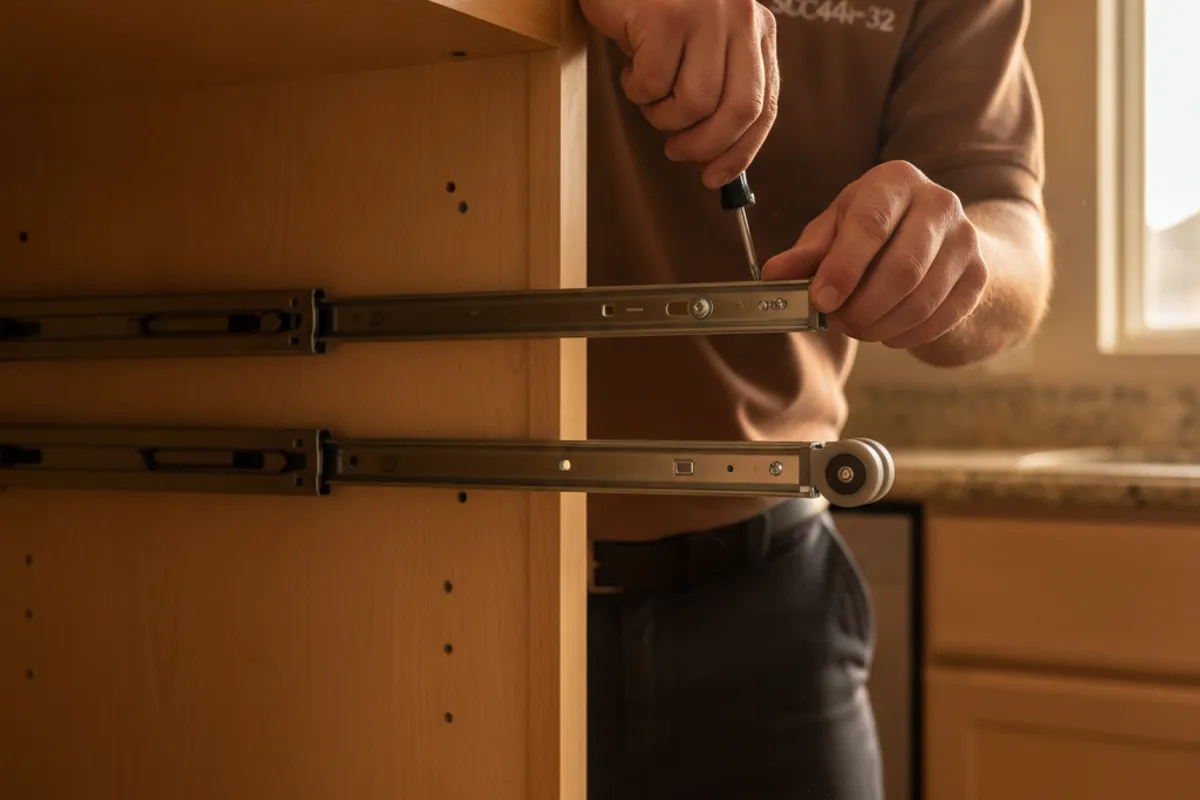
Drawer slides hold the drawer box in alignment and allow it to roll in and out of the cabinet box. A standard side-mount or bottom-mount slide has no deceleration: the drawer rolls in until it hits the back of the cabinet box, which produces a thud.
Soft-close drawer slides have a built-in decelerator that catches the drawer near the end of its travel and brings it to a quiet stop. The effect is similar to the hinge: the drawer closes smoothly rather than slamming.
Undermount soft-close slides are the cleanest option because the slide hardware is hidden beneath the drawer box and visible only when the drawer is pulled all the way out. Side-mount soft-close slides are slightly less expensive and work well too, but the hardware is visible on the drawer sides.
Hinge types and compatibility
Standard concealed hinges (also called European hinges or cup hinges) are the dominant hinge type in San Diego kitchens built after roughly 1990. They mount inside the cabinet box and are invisible when the door is closed. Most modern full-overlay and partial-overlay doors use this type.
If your existing cabinets use older butt hinges (visible on the door edge and the frame) or pivot hinges, the refacing project may involve switching to concealed hinges. Your crew should specify this at the measurement visit. Converting from butt hinges to concealed hinges requires drilling new cup holes in the door and new mounting plate holes in the box, which is standard work during a refacing project.
What to ask about hardware quality
Not all soft-close hinges are equivalent. Ask the crew:
- Which hinge brand do you use? (Blum and Grass are the quality benchmarks. Generic unbranded hinges from overseas suppliers are less reliable.)
- What’s the cycle rating on these hinges?
- Are the drawer slides undermount or side-mount?
The hinge brand is rarely listed in a quote. Ask specifically and write it down. A refacing project with Blum hinges is a materially better long-term result than the same project with $3 generic hinges.
Push-to-open hardware
Some kitchens, particularly contemporary designs without visible pulls, use push-to-open hardware: touch the door face lightly and the mechanism ejects the door to open. This is an alternative to soft-close that works on doors only (not drawer slides). It requires a different type of catch mechanism and eliminates the need for pulls on the door, which suits minimalist designs.
Push-to-open and soft-close are typically not combined: they use different mechanisms that conflict. Decide at the start of the project which approach the kitchen will use.
For an overview of what to expect during a refacing project, including the hardware installation process, see the cabinet refacing service page. For guidance on matching hardware style to door profile and kitchen design, see the soft-close hardware upgrade service page.
Can soft-close hinges be added to existing doors without refacing?
Yes. Soft-close hinges can be retrofitted on existing cabinet doors that use concealed (European cup) hinges as a standalone project. The existing hinge is removed and a soft-close hinge is installed in the same mounting position. Labor runs $10-$25 per hinge for a standalone job. If your doors are in good condition and you’re not refacing, it’s worth doing as a separate upgrade.
Do soft-close hinges fix misaligned doors?
Soft-close hinges include a three-way adjustment: up/down, left/right, and in/out. That adjustment can correct minor door misalignment. If doors are significantly off-square because the box itself is racked, the hinge adjustment has limits. Boxes need to be shimmed square for hinge adjustment to work properly.
How long do soft-close hinges last?
Quality hinges from Blum or Grass are rated for 75,000-100,000 cycles. The hydraulic damper that produces the soft-close effect typically lasts 10-20 years before the effect fades. The hinge itself, as a door-holding mechanism, lasts the life of the cabinet.
The bottom line
Soft-close hinges and drawer slides are worth adding during a refacing project. The incremental cost is $420-$840 on a typical kitchen, and the upgrade makes the kitchen feel more current and reduces daily wear on the cabinet boxes. Specify hinge brand before work starts: Blum and Grass are the benchmarks for quality and longevity.
Call (858) 925-5546 to connect with insured cabinet refacing crews across San Diego County who can walk you through hardware options at the measurement visit. Verify any contractor at cslb.ca.gov before signing.