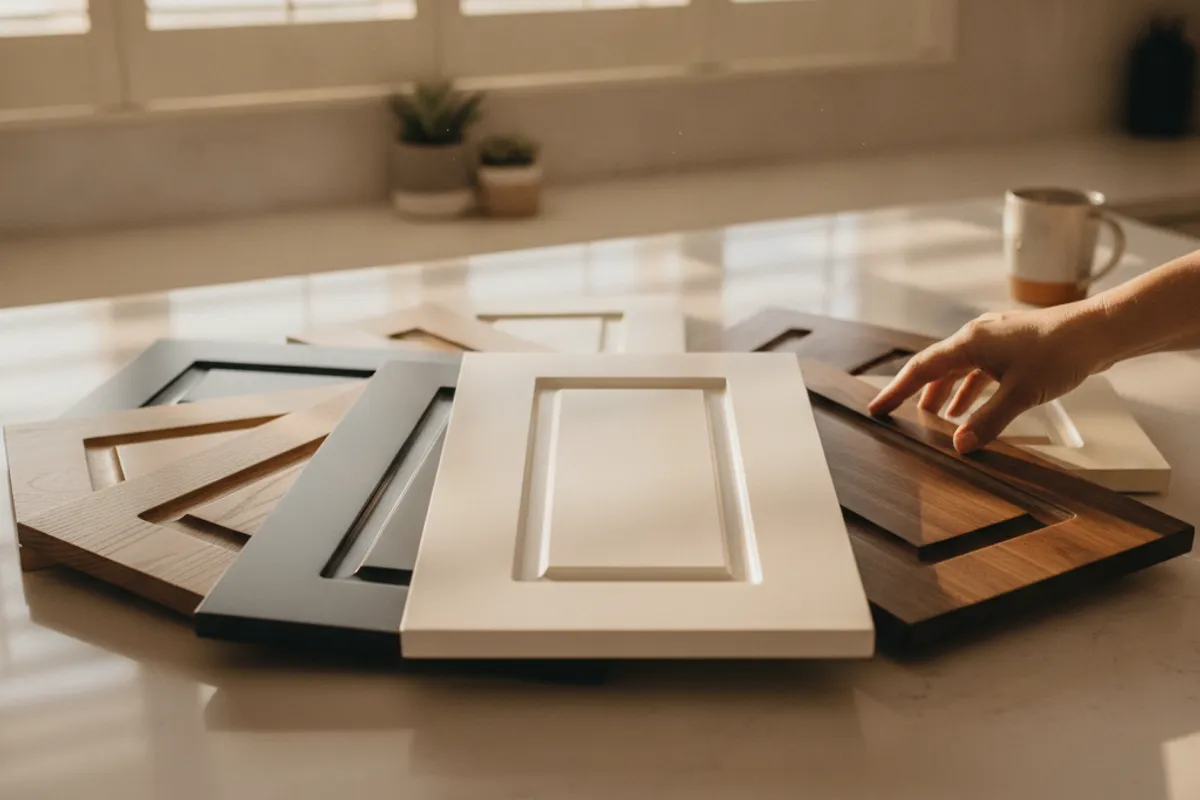
Why door style matters more than almost anything else in a refacing project
In a cabinet refacing project, the doors and drawer fronts are what you see when you walk into the kitchen. The box face veneer is visible at the edges, the filler strips are visible at the ceiling, but the doors are the face of the cabinet. Choose a door style that fits the kitchen and the house, and the project looks intentional. Choose one that clashes with the architecture, and the project looks off even if the workmanship is perfect.
San Diego kitchens cover a lot of ground: craftsman bungalows in North Park and Normal Heights, mid-century modern in Kensington and Mission Hills, Spanish colonial and ranch homes in Rancho Santa Fe and La Jolla, newer tract construction in Chula Vista and Eastlake. Each of those housing styles has door profiles that work well with it and profiles that fight it.
The main door styles for refacing projects
Shaker
Shaker doors have a flat center panel recessed within a square-profile frame. They’re the most popular choice in San Diego refacing projects right now, and for good reason: the profile is clean enough for contemporary kitchens and warm enough for traditional ones. They work in craftsman, transitional, and modern farmhouse interiors. They’re available in virtually every species and finish.
The center panel is the most variable part: a flat MDF panel painted solid white is a different look from a rift-sawn oak panel with natural stain. Same door profile, very different results.
Flat slab
A flat slab door is a single panel with no frame, no routing, no detail. It’s the cleanest contemporary option. Works well in true modern interiors, high-gloss finishes, and horizontal-grain wood applications. Looks out of place in craftsman or farmhouse kitchens where a little detail reads as intentional.
Flat slab doors in white or gray painted MDF are less expensive to fabricate than Shaker doors, which can affect the budget meaningfully on a 35-door kitchen.
Routed panel (raised or recessed)
Raised panel doors have a center panel that rises above the surrounding frame. Recessed panel doors have a center panel that sits below. Both styles read as more traditional than Shaker. They work well in homes with formal dining rooms, classical millwork, and traditional architectural details.
In most San Diego homes, raised panel doors are in decline as a style choice. They were the dominant builder-grade profile from 1985 to 2005, and most refacing projects replacing them are moving to Shaker specifically to get away from the traditional look.
Full overlay vs. partial overlay
This is less about the door’s visual profile and more about how much of the cabinet box face frame the door covers. Full overlay doors are sized to cover nearly the entire face frame, leaving only a small gap between adjacent doors. Partial overlay doors cover less of the frame, leaving more of the box face visible between doors.
Full overlay is the modern standard and the more common choice in San Diego refacing projects. Partial overlay works on face-frame cabinet boxes and is still appropriate for some traditional styles.
How to match door style to your home
Craftsman and bungalow homes (North Park, Normal Heights, Hillcrest, Bankers Hill)
Simple Shaker profile, stained or painted in a warm neutral. The flat center panel reads as honest and simple, which fits the craftsman sensibility. Avoid highly decorative routed profiles or high-gloss contemporary finishes.
Mid-century modern (Kensington, Mission Hills, Point Loma)
Flat slab in a warm wood tone, or Shaker in white. Clean lines work. Traditional raised panel doors fight the architecture.
Spanish colonial and ranch homes (Rancho Santa Fe, La Jolla, Del Mar)
This is where traditional profiles work well. A recessed arched panel or a Shaker door with furniture-style feet at the lower cabinets fits the aesthetic. White or warm cream finishes read as intentional rather than builder-generic.
Newer construction and tract homes (Chula Vista, Santee, Rancho Bernardo, Eastlake)
White or light gray Shaker is the safe choice. It photographs well, appeals to the broadest buyer pool, and doesn’t fight the neutral new construction palette.
Door finish: painted vs. stained vs. thermofoil
Painted MDF doors are the most popular choice in San Diego refacing projects right now. MDF takes paint evenly, doesn’t expand or contract with humidity the way solid wood does, and is less expensive than solid wood. The limitation: MDF edges can chip if hit hard, and paint repairs on MDF are more visible than on wood.
Stained solid wood doors look richer and more natural than any painted option. They cost more, and the color range is limited to tones that work with natural wood grain. The right choice when the goal is a warm, natural-material look.
Thermofoil doors (vinyl film over MDF) are typically found in existing cabinetry, not ordered as refacing replacements. If your existing doors are thermofoil, they’re being replaced, not kept, as part of the refacing project.
For a full overview of what the refacing process involves and how door selection fits into the project, see the cabinet refacing service page. For options on custom door sizes and profiles, see the custom cabinet door options page.
What’s the most popular door style for San Diego refacing projects?
Shaker profile in white or light gray painted MDF is the dominant choice across all San Diego neighborhoods right now. It works for almost every home style and has broad buyer appeal for homes going on the market.
Do I have to choose the same door style for all cabinets?
Most kitchens use a consistent door style throughout. A common variation: glass-panel inserts on upper corner cabinets or display cabinets. The base style stays consistent; the glass substitution adds visual interest at specific locations.
Can I mix door styles in a two-tone kitchen?
Two-tone kitchens, white uppers and a contrasting lower color, are popular in San Diego. The door profile is typically consistent even if the color changes. Mixing Shaker uppers with flat-slab lowers usually looks unintentional.
The bottom line
Shaker profile in painted MDF is the safe choice for most San Diego refacing projects. Flat slab works in true modern interiors. Traditional routed profiles fit craftsman and Spanish colonial homes. Match the door profile to the architecture, not to what looked good in a magazine from a different region.
Call (858) 925-5546 to connect with insured cabinet refacing crews across San Diego County who can show you samples in your kitchen before materials are ordered. Verify any contractor at cslb.ca.gov before signing.